The system is humming away, air is coming out of the vents, and none of it is cold. It is the most common call we take between June and September, and it is genuinely uncomfortable when the outside temperature is sitting above 100°.
The good news is that a fair share of these calls have a cause you can find and fix yourself in ten minutes. The rest need a technician, and knowing which is which saves you both a wasted afternoon and an unnecessary diagnostic fee. Work through this in order.
Start Here: Four Safe Checks
1. Check the thermostat settings
Obvious, and still the answer more often than you would think. Make sure it is set to Cool and the target temperature is a few degrees below the current room temperature.
Then check the fan setting, because this one catches almost everybody: the fan should be on Auto, not On. Set to “On,” the blower runs continuously whether or not the system is actively cooling — so between cooling cycles you get room-temperature air blowing out of every vent. It feels exactly like a broken air conditioner and it is simply a setting. If the display is blank or unresponsive, replace the batteries before you do anything else.
2. Look at the air filter
This is the single most common physical cause of poor cooling. A filter clogged solid after a Texas summer restricts airflow badly. With too little air moving across the evaporator coil, the coil gets too cold, moisture on it freezes, and ice gradually blocks what airflow was left. The system runs and runs, and the house never cools.
Pull the filter out and hold it up to a light. If you cannot see light through it, replace it. If you find ice on the coil or the copper lines, skip ahead to the reset section below — the system needs to be shut off and thawed before it will cool properly again.
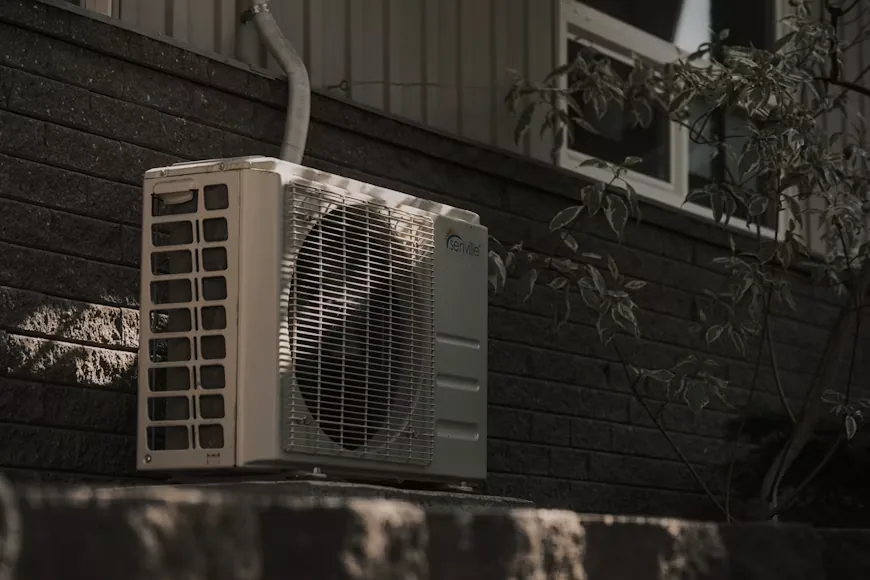
3. Clear the outdoor condenser unit
The outdoor unit exists to dump your home’s heat into the outside air, and it cannot do that if it is smothered. In Fort Worth the usual culprits are cottonwood seed in early summer, grass clippings blown in by mowing, and leaves banked against the fins.
Switch the system off, clear away any debris by hand, and cut back plants so there is roughly two feet of clear space on every side. You can rinse the outside of the fins gently with a garden hose from top to bottom — never a pressure washer, which bends the fins and creates a bigger problem than the dirt did.
4. Check the breaker
Most systems have two breakers — one for the indoor air handler and one for the outdoor unit. If the outdoor breaker has tripped, the fan indoors keeps running while nothing outside does, which produces exactly the “running but not cooling” symptom.
Reset it once. If it trips again straight away, stop. A breaker that will not hold is telling you there is an electrical fault, and repeatedly forcing it is genuinely unsafe.
Change your filter every one to three months — monthly during peak summer, and monthly year-round if you have pets. It is the cheapest thing you can do to stop this happening again, and it is the core of our seasonal maintenance visits.
“It Is Running but Not Blowing Cold” — What That Means
It helps to understand that your air conditioner is really two machines working together. The indoor blower moves air through the house. The outdoor unit, with its compressor and condenser, is what actually removes heat.
When people say the AC is “running but not cooling,” nine times out of ten the indoor half is working and the outdoor half is not. That narrows the problem considerably: a tripped breaker, a failed capacitor, a burned contactor, low refrigerant, or a compressor that cannot start.
Here is a quick test. Go outside while the system is calling for cooling. Is the large fan on top of the outdoor unit spinning? Is the unit making any noise at all? If it is silent, or humming without the fan turning, you have found where the fault lives — and that is a technician’s job rather than a homeowner’s.
How to Reset Your AC Safely
A reset genuinely does clear some faults, particularly after a power flicker or a safety lockout. Do it in this order:
- Turn the thermostat to Off.
- Switch off the breakers for both the indoor and outdoor units, and leave them off for about 30 seconds.
- Switch the breakers back on.
- Wait a full three to five minutes before turning the thermostat back to Cool.
- Set the temperature a few degrees below the room and let it run for 15 minutes before judging it.
That waiting period matters. It is sometimes called the three-minute rule, and it exists because internal refrigerant pressures need to equalise before the compressor tries to start again. Restarting too quickly makes the compressor work against pressure it should not have to — and the compressor is the single most expensive component in the system.
One warning: if a reset fixes things and the same fault returns within a day or two, do not keep resetting. Repeated lockouts mean a safety device is doing its job because something real is wrong.
Should You Turn the AC Off If It Is Not Cooling?
In several situations, yes — and switching it off will often save you money on the repair.
- If you see ice on the coil or the refrigerant lines. Running a frozen system strains the compressor and achieves nothing. Turn the cooling off, leave the fan on Auto, and give it a few hours to thaw.
- If you smell burning or anything electrical. Shut it off at the thermostat and the breaker, and call.
- If water is pooling around the indoor unit, which usually means a blocked condensate drain.
- If the breaker keeps tripping. Leave it off.
If the system is simply underperforming with none of the above, it is fine to keep running while you wait for a technician — it is doing no harm and some cooling beats none in this climate.
Signs the Problem Needs a Professional
These faults are beyond safe DIY territory:
- A frozen evaporator coil that keeps returning. Thawing it treats the symptom; the cause is restricted airflow or low refrigerant, and it will freeze again.
- Low refrigerant. A system does not consume refrigerant — if it is low, it is leaking. A recharge without finding the leak is money spent twice.
- A failed capacitor. The classic signature is a compressor that hums but will not start and an outdoor fan that sits still. Common, quick for a technician, and dangerous to touch yourself.
- A burned contactor or other electrical fault in the outdoor unit.
- Compressor failure. The expensive one — and worth confirming properly, because a dead capacitor imitates it convincingly.
Handling refrigerant is federally regulated and requires certification — it is not a DIY job. Neither is opening the electrical compartment: a capacitor stores a serious charge even with the power off, and people are injured by them every summer. And never keep forcing a breaker that will not stay on.
Why Fort Worth Summers Make These Failures Worse
None of this happens randomly. A Fort Worth system runs almost continuously from May into late September, with attic temperatures well beyond 130° sitting directly on the ductwork and air handler.
Sustained heat is exactly what kills capacitors, which is why they are the most common summer failure in North Texas. It is also why marginal parts pick the hottest afternoon of the year to give up — the fault was building for weeks, and the heat simply chose the moment. Add cottonwood and construction dust fouling the outdoor coil, and you have a system fighting on several fronts at once.
That is also why the checks above matter more here than in a mild climate. A dirty filter that would be a minor inefficiency elsewhere becomes a frozen coil in a Fort Worth July.
When It Is Genuinely an Emergency
Treat it as urgent, not a next-week problem, if the house is climbing above the mid-80s indoors and anyone at home is an infant, elderly, pregnant, or has a heart or respiratory condition. Pets are vulnerable too. Heat illness develops faster indoors than people expect.
Also treat it as an emergency if you smell burning, see smoke, or the breaker trips repeatedly — those are electrical risks rather than comfort problems. Our 24/7 emergency AC repair line exists for precisely these situations, and a real person answers it at 2 a.m.
While you wait: close blinds on the sunny side, move everyone to the lowest floor, run fans to keep air moving, and drink more water than you think you need.
If this is a shop, office or restaurant rather than a home, the stakes are different again — our commercial HVAC team handles rooftop units and after-hours failures so you are not closed for a day.
What to Tell Us When You Call
A two-minute description gets you a faster, cheaper visit, because the technician arrives knowing roughly what to expect and carrying the right parts. Useful details:
- What you have already checked — filter, thermostat, breakers, outdoor unit.
- Whether the outdoor fan is spinning, and whether the unit is humming or completely silent.
- Any ice on the coil or copper lines, and any water around the indoor unit.
- Roughly how old the system is, if you know it.
- Whether the breaker has tripped, and if it tripped again after resetting.
Frequently Asked Questions
How do I reset my AC if it is not cooling?
Turn the thermostat off, switch both breakers off for 30 seconds, then back on. Wait three to five minutes before setting it to Cool so refrigerant pressures can equalise safely.
Should I turn off my AC if it is not cooling?
Yes if you see ice, smell burning, find pooling water, or the breaker keeps tripping. Otherwise it is fine to keep running while you wait for a technician.
Why is my AC running but not blowing cold air?
Usually the indoor blower works while the outdoor unit does not. Common causes are a tripped breaker, failed capacitor, burned contactor, low refrigerant, or the fan set to On instead of Auto.
How do I make my AC cold again?
Set the fan to Auto, fit a clean filter, clear two feet around the outdoor unit, and check the breakers. If it is iced, switch cooling off and let it thaw first.
How do I check whether my AC is cooling properly?
Hold a thermometer at a supply vent, then at the return. A healthy system typically shows a 16–22° difference. Much less than that means it is not removing heat properly.
Need a hand? Our AC repair service runs same-day across the city, emergency cover is available 24/7, and regular maintenance prevents most of these faults in the first place. Serving Fort Worth, Arlington, North Richland Hills and the surrounding area.
Need this fixed today? Call for a straight answer and an upfront price — 24/7.
📞 Call (817) 710-3410admin
Writing about HVAC service, repairs, and costs for Fort Worth, TX homeowners.
Need HVAC Help in Fort Worth?
Tell us what your system is doing and we’ll connect you with a local professional — same-day where possible, with the price agreed in writing before any work starts.
- Same-day appointments available
- Upfront, written pricing
- 24/7 emergency line
Get Your Free Quote
We’ll get back to you as soon as possible. No spam, ever.
Ready to Get Comfortable Again?
Skip the form — the fastest way to get help is a phone call. Tell us what your system is doing and we’ll give you a straight answer and an upfront price.
(817) 710-3410